
In paper references.
Every direct quote should be followed by a footnote with a specific page reference. Additionally there should be no comma between the name and the date:
Cicero tell us ‘labore et dolore magnam aliquam quaerat voluptatem’.1
1. Name date, p. xx.”
Example:
- Cicero 1931, p.36.
(Cicero M.T, (1931) “De finibus bonorum et malorum” IN: Rackham, H.(trans.) De finibus bonorum et malorum with an English translation. Loeb classical library: Cambridge. )
In most possible worlds, when philosophers in St. Andrews talk about a kiss, they refer to a Russell-Whiteheadian kiss. This is ‘a formal kiss in which each lip and tongue movement is rigorously and completely defined, even though it ends up seeming incomplete somehow’.2
2. Lode 1992.
Books in General
Non-direct quotes can go into the text (when this helps the readability of the article).
Example:
This view is attributed to Goodman and Quine (1947) and Bloomfield (1933, 1936) ….
Which quote marks:
Authors should use single quotes when quoting from a text and double quotes for scare quote or for emphasis.

On the use of Ibid
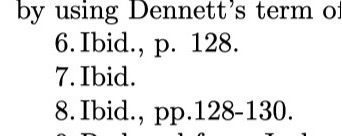
Unlike APA at Apophansis we use Ibid. (for a text from the same page as the pervious) and Ibid., p. xx. (for something in the same work but on a different page).
P. vs. PP
p. for a single page and pp. for more than one
Example:
Bibliography entries:
Book:
Name, Initial. (Year). Name of the book. Place: Publisher.
For example:
Lorenz, H. (2006). The Brute Within: Appetitive Desire in Plato and Aristotle. Oxford: Clarendon Press.
Kenny, A. (2006). Meditations on First Philosophy. Cambridge: Cambridge University
Journal article:
Name, Initial. (Year). “Name of Article”. Name of Journal, vol (n.), pp. XX-XX.
For example:
Srinivasan, A. (2020). “Radical externalism”. The Philosophical Review, 129(3), pp. 395-431.
Zagzebski, L. (1994). “The inescapability of Gettier problems”. The Philosophical Quarterly, 14(174), pp. 65-73.
Chapter in a book:
Name, Initial. (Year). “Title of chapter”. In: Name, Initial (ed.). Name of the book. Place: Publisher, pp. XX-XX.
For example:
Cooper, J. M. (2021). “Plato’s Theory of Human Motivation”. In: Cooper, J. (ed.). Reason and Emotion: Essays on Ancient Moral Psychology and Ethical Theory. Princeton: Princeton University Press, pp. 118-137
Online source:
Name, Initial. (Year). “Title of page/Article” Name of Website(if relevant). URL = XYZ.
For example:
Maes, H. (2023). “Erotic Art”, The Stanford Encyclopedia of Philosophy. Available from: <https://plato.stanford.edu/archives/spr2023/entries/erotic-art/>.
Patterson, O. (1982). Slavery and social death: a comparative study. Available from: https://hdl.handle.net newline/2027/heb03237.0001.001.
 Apophansis